G.
Kock © 2011–16
SCRIPOPHILY IN FINLAND
An overview of the state of the hobby in this country.
The same article in Swedish
und auf Deutsch.
Production of share certificates
From the early 19th century up to the 1940s vignetted certificates of the highest
quality and beauty were printed by lithography. The cheaper method being
letterpress. The most famous litho printer in Finland was Tilgmann.
Another large one was Frenckell. The bank note printers, that had
previously produced bonds, started printing partly line-engraved (recess)
shares* around 1965.

Beginning in 1934 Frenckell started to add a patented (system Thörnblad)
dorsal colour ribbon to one margin of the
securities in order to enable fast distinguishing of different
denominations. This ingenious invention never went out of use. For roughly
the last 130 years share certificate folded sizes here have generally been
close to the US letter (A) size of 8.5" x 11". Since the 1940s the exact
metric A4 of 8.3" x 11.7" has been the norm. The smallest size of a
certificate is Viasveden Laiva's 11x16 cm and the largest Åbo Skeppsvarv's
33x49 cm.
Transfers of share ownerships were noted on the certificates, which were
rarely physically replaced. In the 1980s it was still possible to get
papers issued in the late 19th century when trading on the stock
exchange. But by that time the total costs of just substituting a used-up
sheet of
coupons (between the folded cover) had exceeded the costs of replacing the
entire stock certificate.
Trading on the stock market boomed in the 1980s with a lot of new issues. In
1984 Polytypos entered the security printing market and adopted a new kind
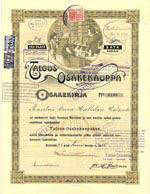
of single A4 sheet shares with attached coupons (picture),
resembling bonds and the old French system. This type is not appreciated by the scripophilists.
Physical shares soon became impossible to handle with the enormous expansion
of trading. From 1992 to 2000 all quoted securities were therefore transferred
into a centralised electronic book-entry system. The very last
quoted company issue of paper shares was in 1995.
 Availability of collectable certificates
Finland was an autonomous part of the Russian Empire from 1809 to 1917.
A forerunner to the stock exchange was
founded in 1862. The first act regulating limited liability companies was instituted in
1864. Stock certificates of about ten companies issued before 1865 are
known to have survived, the oldest being from 1762 (the only one from the 18th
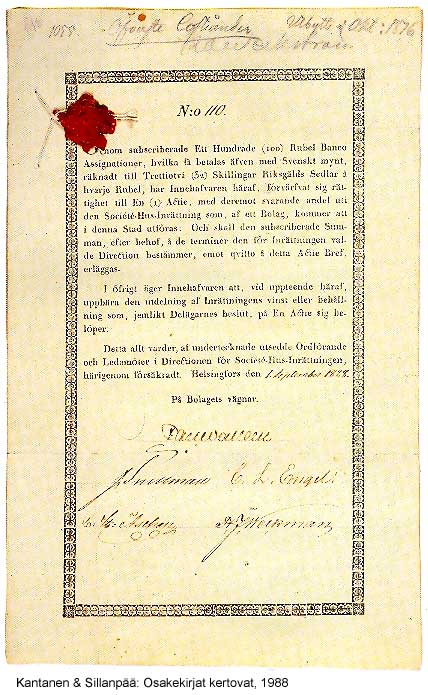
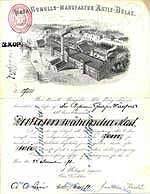
century). The oldest one in private hands is from 1828 (pictured >). About
220 companies have issued 19th century certificates
that are now owned by collectors. These shares are usually inscribed in
Swedish, the later ones gradually more predominantly bilingually or in Finnish.
Papers issued before 1870 are rare and those newer ones before the new law
of 1896 are for the most part uncommon. After that availability improves
drastically because the economy of the country had developed rapidly. It
can be estimated that shares of about 3 100 different companies (not
counting items in museums and archives) of all times are known to
collectors – much fewer than Sweden and very little by international comparison. 3 200
joint-stock companies were formed up
to 1912 only (in which year the stock exchange was founded).
The number of identical copies of the same item is often modest and there
are many unique ones. Today's high market price level has furthered the offering
for sale of hitherto unknown items from the public.
How are share certificates collected?
Due to the limited number of companies and shares available most
collectors are general collectors. However, quite a few specialise in
papers of listed companies. It is also
feasible to limit the collection theme to a certain region (such as one's native
place, or ceded Karelia) or a particular time period. Collecting by industry would
require the inclusion of foreign items.
If there are any industries that are both popular and somewhat accessible it would be
shipping companies, banks and railways.
Here only a few enthusiasts are interested in different years of issue
or denominations of the same share – too difficult to obtain. Restricted and
unrestricted (for foreigners)
ones are not separated either. Ordinary and preferred shares (as well as
class A and B ones), however, sometimes use to be differentiated. A collection
comprising 1 000 companies is a big one. We have no forgeries, only
a couple of fakes, but a few non-fraudulent reproductions have been made in Germany.
 Bonds. Foreign stock certificates
A great variety of repaid bond certificates (>) are sold on
the collectors' market for just a few euros each, because when the loan
had been paid the stub remained with the owner. We have loans issued by the State
(Republic) and by mortgage banks and by private companies for the public,
as well as convertibles and warrants. Of certain
interest are bonds issued abroad by Finnish entities. – Shares of co-operative
societies often look uniform and are thus of less interest.
Foreign stock certificates, especially
American and German ones, are increasingly common, and cheap, on the scripophilic market here
too, but attract only limited interest. No foreign country is more popular than
another – it is the certificate as such that can be tempting –
although neighbouring Sweden has a couple of non-serious followers. World
famous corporations would draw buyers, but are usually not available. Foreign companies with a Finnish
background are sought after.
Item states encountered
Issued share certificates, whether cancelled or not, are the
most wanted ones. Earlier the shareholder could specifically ask the company
for the favour of getting back his paper, made void by hand stamping or
punching. Few owners did. Sometimes certificates were mislaid and are invalid but uncancelled
when found. They are now appreciated. Occasionally items have been
released from company archives.
A great portion of the items in collections are from bankrupt or otherwise
defunct enterprises. No cancellation. Printers' specimen copies and the
companies' own unissued forms are frequently seen. They are of
lesser value but are usually the only way to obtain certain certificates.
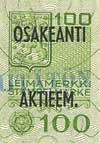 Bearer shares were only rarely used in Finland. The very oldest
certificates are denominated in Russian Roubles. The Markka was in use
from 1862 to 1962 and the New Markka (100:1) from 1963 until 2001. Today
the currency is the euro. From
1916 to 1966
revenue stamps (>) were stuck to certificates. Explanation of the red
1946 adhesive.
Bearer shares were only rarely used in Finland. The very oldest
certificates are denominated in Russian Roubles. The Markka was in use
from 1862 to 1962 and the New Markka (100:1) from 1963 until 2001. Today
the currency is the euro. From
1916 to 1966
revenue stamps (>) were stuck to certificates. Explanation of the red
1946 adhesive.
The Finnish Catalogue
The first (since 2006) catalogue of all known certificates in the hands of
collectors is available updated on the net h e r e . It is collector maintained
and there is no charge for its use. Note that "Osakeyhtiö", "Oy" and
"Ab" (all meaning "Ltd") have been disregarded when sorting that list
alphabetically. "Helsingissä" just means "in Helsinki". An appendix with
additional company information (in Finnish) is linked to when applicable and there is also
a list by industries. In 2008 a dealer printed a list.
Prices and how we buy and sell
In the over-optimistic 1980s people unconcernedly spent money on e.g.
collectables. During the next decade scripophily prices either went down somewhat, or
the market contracted. Now a German managed to cheaply gather the largest
collection (now sold) of Finnish certificates. In the following years demand
improved and prices at least regained their pre-depression levels. The
foundation of the Society in 2007 resulted in a veritable boom and in a
few years prices
perhaps tripled, and for some time we saw signs of overheating.
The universal criteria for valuing items apply here too. A common
paper will typically cost 15 to 25 euros. If the price exceeds 100 euros it can be
considered expensive. The highest price paid in Finland is 900 euros in
November 2011 for a Kägelban
(English summary) certificate.
 The most important Finnish scripophilic market (for buying and for selling,
continuously) can be found online at huuto.net (a local site similar to eBay).
No buyer's commission is charged on huuto.net. In addition we have several other
general
auctions (both room and web sales, incl. numismatic ones), as well as some
ephemera e-commerce shops that sell certificates at fixed prices. The
online shops became active less than ten years ago; the first specialised one in 2004.
The most important Finnish scripophilic market (for buying and for selling,
continuously) can be found online at huuto.net (a local site similar to eBay).
No buyer's commission is charged on huuto.net. In addition we have several other
general
auctions (both room and web sales, incl. numismatic ones), as well as some
ephemera e-commerce shops that sell certificates at fixed prices. The
online shops became active less than ten years ago; the first specialised one in 2004.
Finland has no scripophily bourses, but the Society offers efficient and
free assistance in their auctions to all who want to sell Finnish items.
The Society does not charge any commission. Of course there are private
buyers too.
The collectors and their Society
The first scripophilists started collecting in the late 1970s. In 1980 Mr. Erkki Borg,
a numismatics dealer, published a book with, among other content, images of old securities. In
1986 the collector Mr. Pekka Kantanen established an
unofficial auction club. It ceased operating, however, after two years. In 1988
he and Mr. Kari J. Sillanpää wrote Osakekirjat kertovat, a
magnificent illustrated volume with tri-lingual text, including English.
The book is still easy to obtain second hand.
Those club auction catalogues of the 1980s had more than 100 different subscribers, but
most of them were not true scripophilists. During the economically
difficult years of the 1990s the number of real collectors was reduced to maybe
just a dozen – during the very period when printed shares were being abolished.
After the 1990s interest slowly improved. Now the Society
has about 50 members, i.e. nearly all the active collectors in Finland.
On 1 August 2007 the Share Certificate Collectors Society, Osakekirjakeräilijät ry
(OKK), was formally founded with Mr. Kantanen as initiator and chairman. It is a registered non-profit organisation
and a member of the Finnish Numismatic Society. OKK's activities
include monthly online auctions open to the public, a web
site, various meetings, advice regarding the hobby, its dissemination,
as well as charitable activities. Most
of the auction sellers are members, but anybody may submit lots for sale.
OKK is the sole
association.
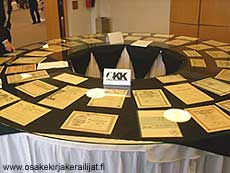 Shows/exhibitions (>) are unusual but have been arranged by the Society or
by investment fairs. Numismatic societies regularly run their own bourses and
the Share Certificate Collectors Society used to take part in such twice a
year with a table of their own, mainly for public relation reasons.
Shows/exhibitions (>) are unusual but have been arranged by the Society or
by investment fairs. Numismatic societies regularly run their own bourses and
the Share Certificate Collectors Society used to take part in such twice a
year with a table of their own, mainly for public relation reasons.
More business history information (on this web, in Finnish)
A descriptive list of all my English articles on the net.
Suomalaisia
Arvopapereita Oy (incl. Bensow), an early equity fund.
Korvausosakkeiden Hallintoyhteisö, compulsory
government holding co 1945.
German
companies in Finland confiscated by the Soviet Union 1944.
Bibliography of company history books.
Facts about all former quoted companies (link
list at the bottom of page).
List of the different business history articles on this web.
All joint-stock companies founded
in Finland before 1913.
Articles about individual Finnish companies (in Finnish):
Seurahuone 1828,
Kägelbanbolaget 1860,
Privatbanken (PDF),
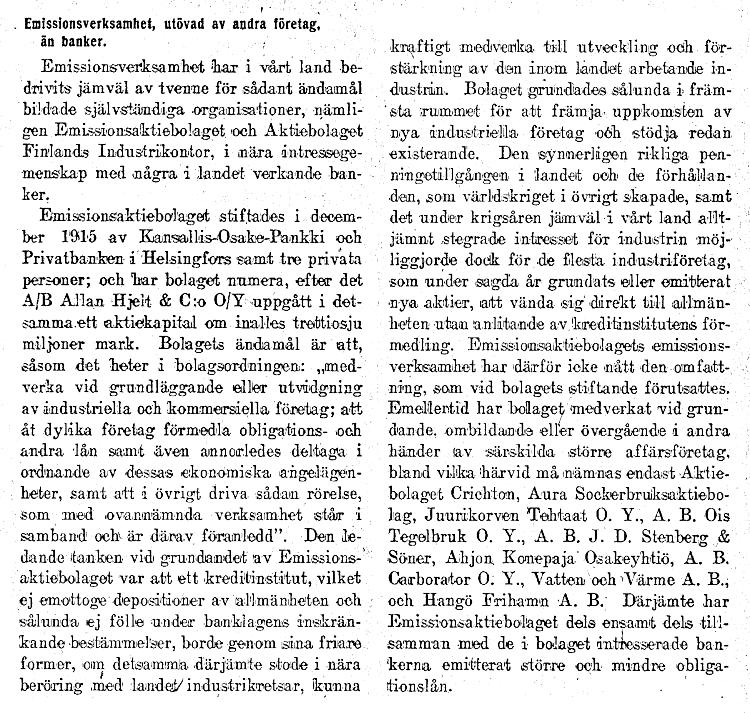
Emissioniyhtiö,
Helsingin Makasiini,
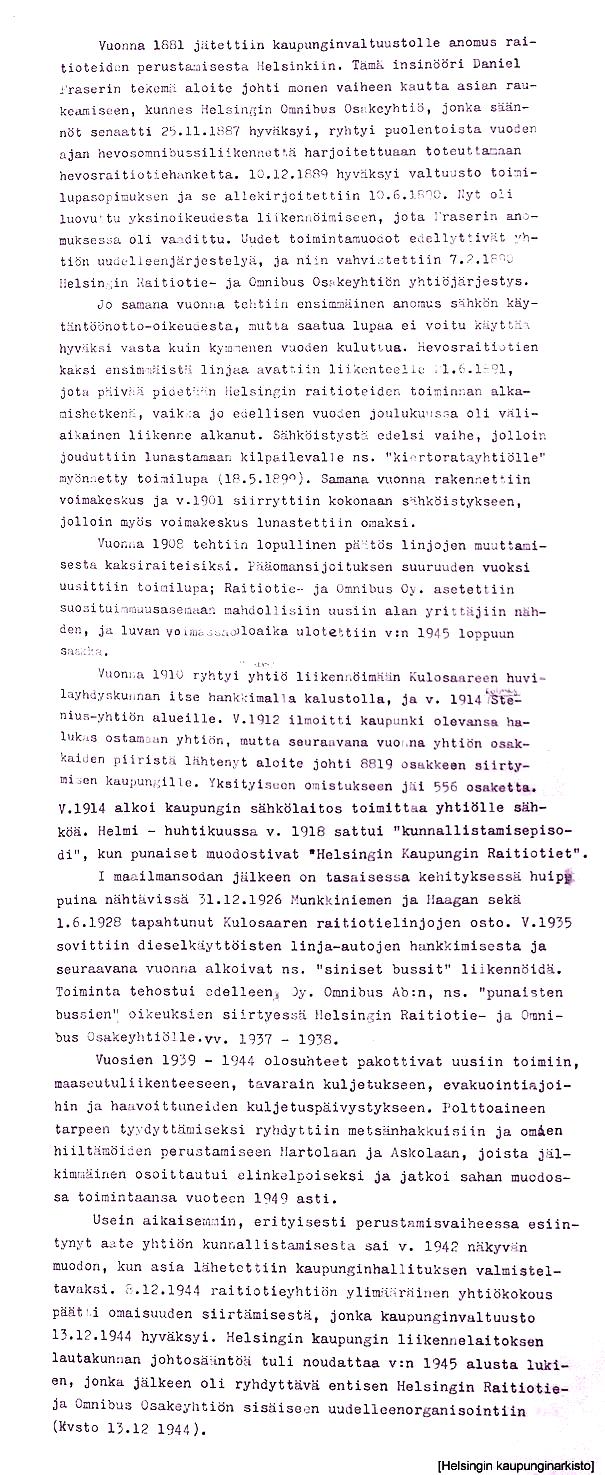
Helsingin Raitiotie ja Omnibus,
Vaasan Puuvilla bond 1871.
Articles about individual foreign companies (in ENGLISH):
Borgå Ångfartygs Ab
(Finland),
Järnvägs Ab Fredrikshamn (Finland);
Companhia de
Moçambique,
Mines de Balia-Karaïdin
(Turkey),
Mines d'Or de Kilo-Moto (Belgian
Congo),
Banque Industrielle de Chine (Paris),
La España Industrial (Spain).
* "Share" has been used here as a synonym for "(share) certificate".
Address of this web page
www.porssitieto.fi/osake/scripophily.html
|